
In institutional construction, educational and laboratory projects are often discussed in the same breath. On paper, that makes sense — both environments involve casework, both serve learning and research functions, and both are frequently delivered within the same capital programs. In practice, however, treating them as interchangeable is one of the fastest ways to introduce avoidable risk into a project.
From the manufacturing side, the differences between educational and laboratory casework show up long before anything reaches the shop floor. They appear in how drawings are developed, how coordination is handled, and how early decisions either support or undermine execution later. Most issues we see do not originate in fabrication or installation. They originate much earlier, when scope and expectations are defined without fully accounting for how the space will actually function.
As one of our project leaders often says, “Casework problems rarely start on site. They usually start when assumptions go unchallenged during design.”
Educational environments tend to reward standardization. Classrooms, administrative spaces, libraries, and support areas are typically designed for heavy daily use, long service life, and consistency across rooms, buildings, or entire campuses. From a planning standpoint, the most successful educational projects are those where layouts, materials, and details repeat predictably. That repeatability supports efficient fabrication, reduces complexity during installation, and makes long-term maintenance easier for owners.
This approach aligns with how many districts and university systems operate. Capital improvements are often phased, incremental, or spread across multiple facilities. Standardized casework allows those programs to scale without reintroducing risk at each phase. National education facility data supports this reality: the majority of public school construction work in the U.S. involves renovations, additions, or multi-year upgrades rather than single, isolated builds, reinforcing the value of repeatable solutions.
Laboratory environments operate under a different set of constraints. While durability still matters, precision and coordination become far more critical. Laboratory casework must integrate seamlessly with mechanical, electrical, plumbing, and equipment systems. Clearances, workflows, and safety considerations all influence how casework is laid out and installed. Small discrepancies that might be absorbed in a classroom setting can quickly become disruptive in a lab.
We’ve seen this firsthand. A dimension that’s off by a fraction of an inch, or a utility that isn’t fully coordinated during design, can cascade into rework, delays, or costly adjustments once fabrication is underway. Industry guidance from organizations focused on laboratory planning consistently emphasizes early coordination between casework, equipment, and building systems for this reason. In laboratory environments, there is far less tolerance for assumption.
This is where design-assist becomes especially valuable. While early manufacturer involvement benefits all institutional projects, its impact is amplified in laboratory settings. Engaging early allows the team to resolve constructability questions before specifications are locked, align casework with equipment and utilities, and identify conflicts that may not be obvious in schematic drawings. Educational projects can often accommodate modest changes during construction. Laboratory projects rarely can.
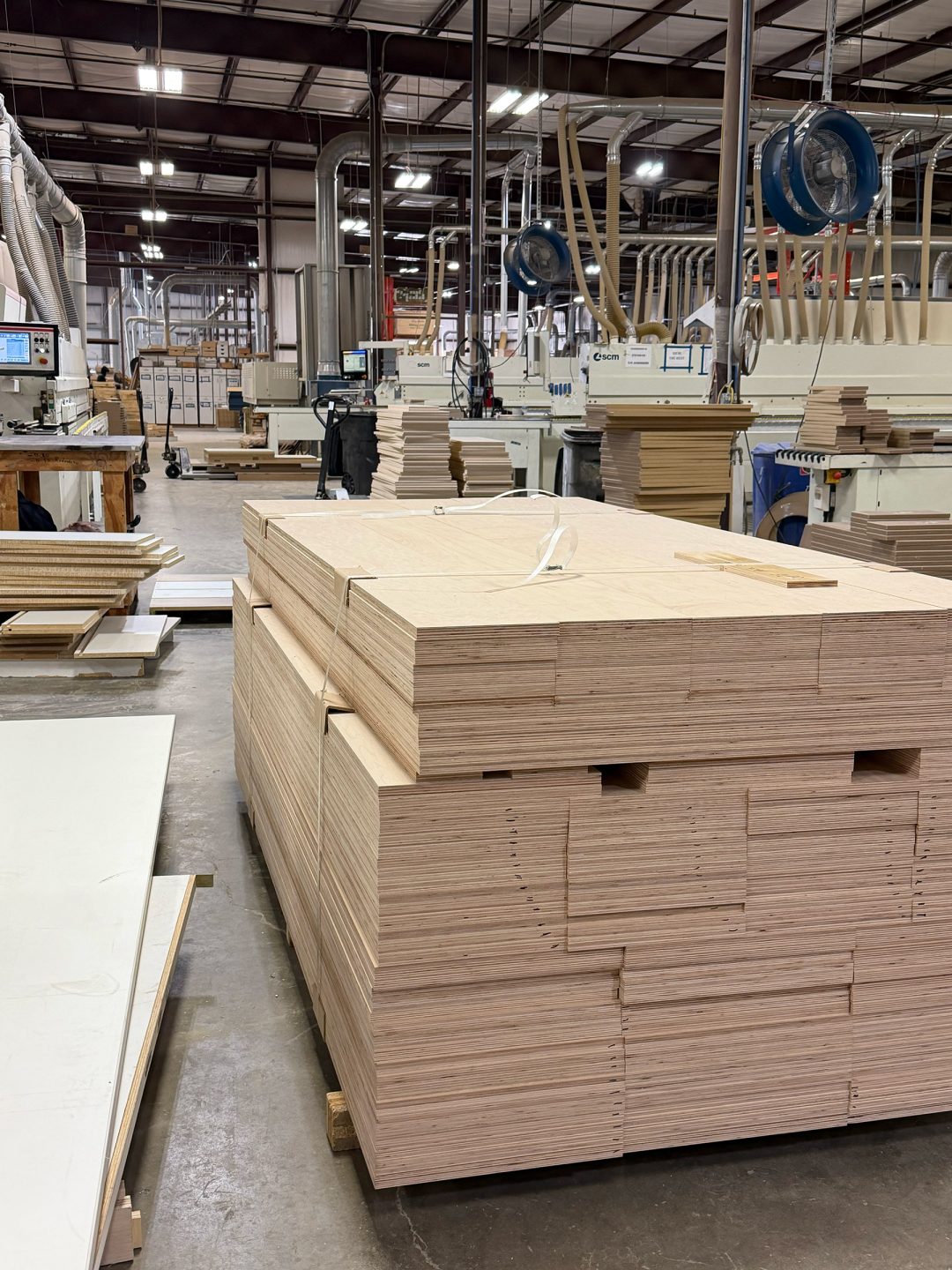
Fabrication reflects these differences as well. Educational casework typically benefits from standardized components and repeatable production runs, which support efficiency and schedule predictability. Laboratory casework, by contrast, often requires a higher degree of customization, tighter tolerances, and more rigorous quality control. Understanding which model a project requires — or where it falls along that spectrum — is essential for accurate scheduling and realistic expectations.
Installation is where these planning decisions ultimately reveal themselves. Educational installations often progress in a linear, room-by-room manner. Laboratory installations are more tightly sequenced, frequently dependent on the readiness of other trades, equipment delivery, and inspections. Poor coordination at this stage doesn’t just affect casework; it can disrupt the broader construction schedule.
Industry research consistently shows that trade coordination remains one of the most common sources of delay on complex institutional projects. In our experience, the projects that avoid these issues are the ones where teams acknowledge early that educational and laboratory environments demand different approaches — and plan accordingly.
At Jericho Woodworks, our role is to help teams make those distinctions early. We support both educational and laboratory environments by engaging during design, maintaining in-house fabrication for quality control, and coordinating delivery and installation in alignment with construction schedules. That structure allows us to support standardized, large-scale educational programs and precision-driven laboratory spaces without forcing one model onto the other.
“Our job isn’t just to build casework,” one of our operations leaders often notes. “It’s to help the project work the way it’s supposed to.”
For architects, general contractors, and institutional owners, recognizing the practical differences between educational and laboratory casework early leads to clearer scopes, fewer surprises, and more predictable outcomes. Most successful projects are not the result of heroic effort later — they are the result of informed decisions made early.
If you are planning an educational or laboratory project and want to align casework planning from the outset, our team is available to support early coordination and design-assist discussions.