
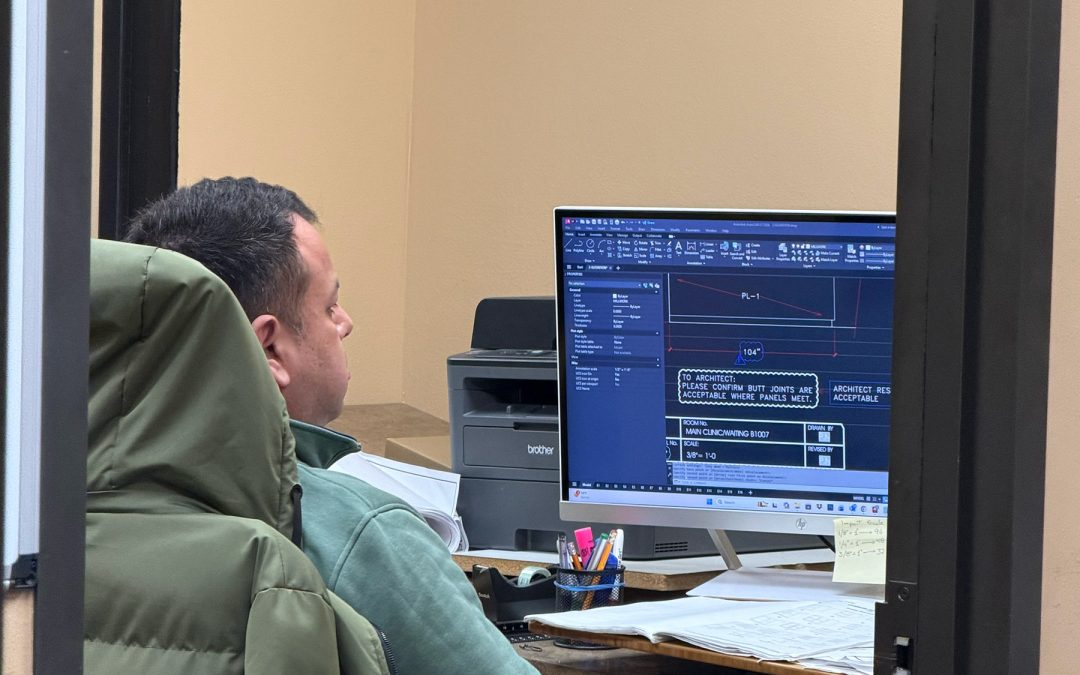
Design-assist is one of those terms that gets used frequently in institutional construction, but not always consistently. In some cases, it means early collaboration. In others, it becomes shorthand for “we’ll figure it out later.” From our perspective as a manufacturer, the difference between those two interpretations often determines whether a project runs smoothly or becomes reactive.
We’ve worked on institutional projects where design-assist fundamentally improved outcomes — and others where it was introduced too late to make a meaningful difference. The distinction isn’t philosophical. It’s practical. Design-assist only works when it is treated as a planning tool, not a contingency plan.
As one of our senior project managers puts it, “Design-assist doesn’t eliminate problems. It moves them earlier, when they’re cheaper and easier to solve.”
Institutional casework sits at an intersection point in a project. It touches architecture, engineering, utilities, finishes, equipment, and installation sequencing. When those interfaces are left unresolved until drawings are issued for fabrication, even small assumptions can ripple into schedule pressure and field coordination issues. Design-assist exists to surface those assumptions before they harden into constraints.
On well-run projects, early manufacturer involvement helps clarify scope in ways that drawings alone often cannot. We review layouts with constructability in mind, flag areas where tolerances are tight, and identify details that may appear straightforward on paper but become problematic in fabrication or installation. This isn’t about redesigning intent — it’s about aligning intent with reality.
Educational environments illustrate this well. Casework layouts may be repeated dozens or hundreds of times across a campus or district. Design-assist allows teams to validate those standards early, ensuring they can be fabricated efficiently and installed consistently. Small improvements made once during design can save significant time and cost when multiplied across a large program.
Laboratory environments raise the stakes even further. In these spaces, casework must align precisely with utilities, equipment, and workflows. Design-assist allows the team to coordinate these elements before fabrication begins, rather than discovering conflicts when adjustments are limited and expensive. In our experience, laboratory projects that skip or compress this phase almost always pay for it later.
Industry research supports this observation. The Construction Industry Institute has consistently found that early involvement of key trade partners improves cost certainty and schedule performance on complex projects. The reason is straightforward: fewer unknowns remain when execution begins. Problems don’t disappear — they’re simply addressed when options still exist.
Design-assist also changes the dynamic between project partners. When manufacturers are engaged early, communication becomes more direct. Questions are resolved through discussion rather than RFIs. Decisions are made collaboratively rather than defensively. That shift alone can reduce friction during construction.
Of course, design-assist only works when expectations are clear. It requires defined roles, timely feedback, and a willingness from all parties to engage early. When those conditions are present, the benefits compound. When they are not, design-assist risks becoming another layer of process without impact.
At Jericho Woodworks, we approach design-assist as an extension of execution. Our goal is not to add steps, but to remove uncertainty. We focus on identifying coordination issues early, aligning fabrication with project schedules, and supporting installation sequencing that works in the field. That approach allows project teams to move forward with confidence rather than contingency.
“Our best projects are the ones where fabrication feels almost boring,” one of our operations leaders often remarks. “That usually means the hard thinking happened early.”
For architects, general contractors, and institutional owners, the value of design-assist lies in its timing. When used as intended — early, collaboratively, and with clear purpose — it becomes one of the most effective tools available for managing risk in institutional casework projects.
If you are considering design-assist on an upcoming project and want to understand how early manufacturer involvement could support planning, coordination, and execution, our team is available to have that conversation.